For a lot of dog owners, getting a fence is not really about the fence.
It is about being able to open the back door and let the dog outside without immediately wondering where they went.
You want them to have room to run around, sniff everything in sight, lie in the sun, and generally do whatever dogs decide is important that day.
At the same time, you would probably rather not spend every five minutes checking to make sure they have not found a new way into the neighbor’s yard.
That is where a good backyard fence makes life a whole lot easier.
The problem is that dogs are different.
A fence that works perfectly for a small older dog may barely slow down a young German Shepherd. Some dogs jump. Some dig. Some squeeze through gaps that do not even look big enough for them. Others spend half the afternoon barking through the fence because they can see another dog walking down the street.
So when homeowners in Newcastle, Blanchard, and surrounding Oklahoma communities ask what the best fence for dogs is, there really is not one answer.
It depends on the dog.
It also depends on the yard, the amount of privacy you want, Oklahoma weather, and how much maintenance you are willing to deal with.
Here are some things worth thinking about before choosing a fence for your dog.
It is easy to get caught up looking at fence photos.
Wood looks nice.
Vinyl looks clean.
Metal can look really sharp around the right home.
But your dog probably does not care what the fence looks like.
They care about whether they can get over it, under it, around it, or through it.
Before choosing anything, think about how your dog behaves outside.
Do they jump when they get excited?
Do they dig?
Do they chase squirrels along the property line?
Do they bark whenever another dog walks past?
Do they try to squeeze through small spaces?
A calm Labrador that mostly wants to sleep under the patio table has very different fencing needs from a young Husky that treats every backyard boundary like a personal challenge.
Knowing which dog you have makes the rest of the decision much easier.
One of the first things dog owners usually ask about is height.
And it matters.
A shorter fence may work perfectly well for small dogs that have no interest in jumping. Larger dogs and athletic breeds can require considerably more height.
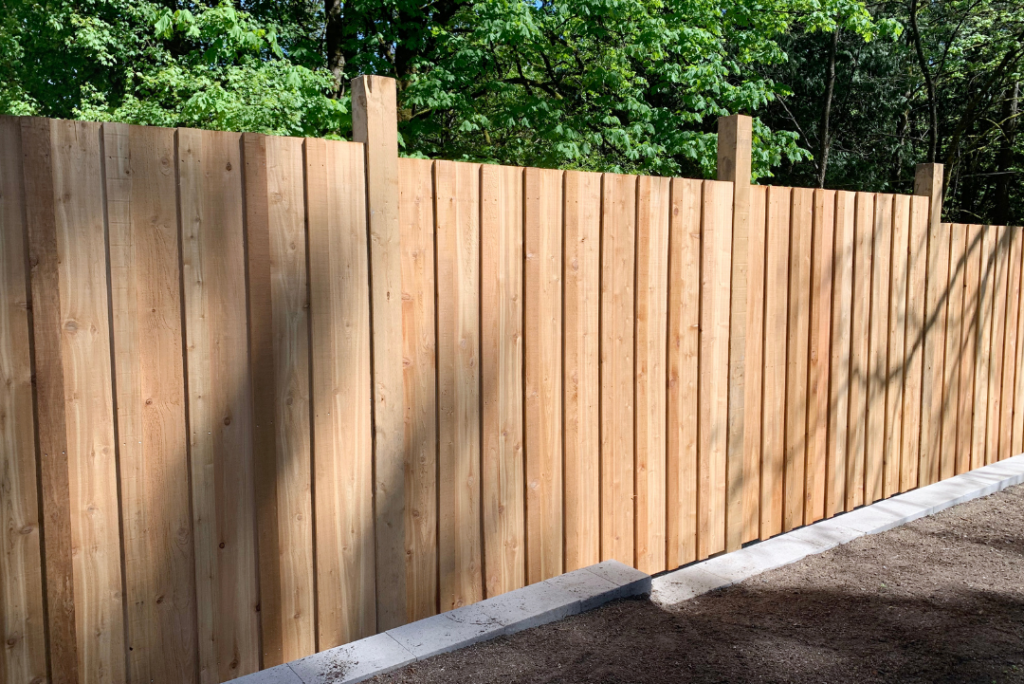
For many homes, a six foot privacy fence provides a comfortable barrier for medium and large dogs.
But height alone does not guarantee anything.
Some dogs are surprisingly talented climbers. Chain link, for example, can give certain dogs something to grip with their paws.
Others can clear fences you would never expect them to jump.
That is why it helps to think about your dog’s actual behavior rather than choosing a height based only on breed or size.
You should also check local fence height requirements and any HOA restrictions before deciding on a taller fence.
There is a reason traditional wood privacy fencing remains popular with dog owners.
It blocks the view.
That may sound like a small benefit, but anyone who owns a reactive dog knows how much difference it can make.
If your dog can see:
people walking past
other dogs
cars
delivery drivers
children playing nearby
they may spend a lot more time running along the fence and barking.
A solid wood privacy fence removes many of those visual triggers.
It also creates a backyard that feels more private for the people living there.
Wood can be especially useful in neighborhoods where houses are relatively close together.
The downside is maintenance.
Oklahoma sunshine, rain, and changing temperatures can be hard on exposed wood. Over time, untreated boards may fade, crack, or absorb moisture.
Regular Fence Staining and Sealing can help protect the wood and keep the fence looking better for longer.
For homeowners who like the natural appearance and do not mind occasional maintenance, wood remains a really practical choice.
Some homeowners like the idea of a solid privacy fence but do not want to stain it every few years.
That is where Vinyl Fencing can make a lot of sense.
Dove Hill Fencing installs vinyl fencing for privacy and property boundaries in Newcastle, and the material is designed to provide a solid barrier while requiring relatively little ongoing upkeep.
For dog owners, that solid construction offers another advantage.
There are no spaces between traditional pickets for dogs to squeeze through or spend all day staring through.
It also means fewer visual distractions.
Vinyl does not need staining, and cleaning is usually fairly simple.
That can be a big benefit when you have dogs that enjoy muddy Oklahoma afternoons a little more than you do.
Of course, installation still matters.
A solid vinyl panel catches wind, so secure post setting is important. That is especially true on open Oklahoma properties where the yard receives a lot of wind.
The fence may be low maintenance, but the structure underneath still has to be built correctly.
Not every dog needs a solid privacy fence.
Some are perfectly happy seeing what is happening outside the yard without trying to escape.
In those situations, Metal Fencing can be a really attractive option.
Dove Hill describes its metal fencing as a durable, low maintenance option that provides secure boundaries without completely blocking visibility.
That makes it especially useful around front yards or properties where homeowners want to preserve an open view.
The important detail for dog owners is spacing.
A small dog may be able to fit between openings that would never be a concern for a larger breed.
Before choosing a decorative metal style, look carefully at the spacing near the bottom and between vertical sections.
If your dog can get their head through something, there is a decent chance they will eventually try to get the rest of themselves through too.
Chain link is practical.
It provides visibility, covers large areas efficiently, and can work well for many dogs.
For larger yards, it can also be more practical than installing a full privacy fence around the entire property.
There are a few things to think about, though.
Some dogs become more reactive when they can see everything happening outside the yard.
Others may try to climb the fence.
Small dogs also require attention to the bottom edge and any gaps around gates.
So chain link can be a great solution, but it works best when it matches the dog’s behavior.
Some dogs could not care less about jumping.
Their escape route is underground.
You may install a beautiful six foot fence and discover two weeks later that your dog has started an excavation project underneath it.
For diggers, the bottom of the fence matters just as much as the top.
The goal is to avoid large gaps between the fence and the ground.
Certain situations may also call for additional barriers near the base of the fence.
It is worth checking the fence line regularly too.
Dogs tend to return to places where they have successfully dug before, so catching a small hole early is much easier than dealing with a full escape route later.
Oklahoma soil can make this especially interesting.
After rain, some areas become easier to dig. During dry periods, gaps can also appear as clay soil contracts.
That is another reason the fence should be designed for the actual property rather than simply copied from another yard.
You can build a strong fence all the way around the yard and still have trouble if the gate is not right.
Dogs are remarkably good at finding the one weak spot.
Maybe there is a gap underneath.
Maybe the latch can be bumped open.
Maybe the gate has started sagging and no longer closes completely.
Whatever the reason, gates deserve extra attention when pets are involved.
A good dog friendly gate should close securely and have a dependable latch.
It should also sit close enough to the ground that your dog cannot easily squeeze underneath.
If children regularly use the gate, think about latch placement too.
You want something that is convenient for the family but difficult for the dog to accidentally open.
One thing homeowners sometimes miss is how much the ground changes along a fence line.
A fence may sit perfectly close to the soil when it is first installed.
Then rain causes erosion.
Dogs run along the same path every day.
The soil settles.
Suddenly there is a gap underneath one section.
For a large dog, that might not matter.
For a Chihuahua or another small breed, it could be an open door.
Walking the fence line every so often and checking for new gaps is a simple habit that can prevent a lot of problems.
A fence for dogs still has to survive Oklahoma weather.
Solid privacy fences are great for reducing distractions, but they also catch more wind than open styles.
That does not mean you should avoid them.
It simply means the posts, spacing, and installation need to match the fence.
A yard surrounded by homes and mature trees may experience wind differently from a property beside an open field.
That is why there is no single installation method that makes sense for every backyard.
The fence needs to fit the site.
We have talked about Oklahoma clay soil in several of our other fence guides because it affects almost everything.
Clay expands when it becomes wet and contracts as it dries.
Over time, that movement can put pressure on fence posts.
If the posts begin shifting, you may eventually notice:
a leaning fence
gaps underneath sections
a gate that no longer lines up
panels that look uneven
Those are not just appearance problems when you have dogs.
A new gap can become an escape point.
Proper post depth and installation are therefore part of pet safety too.
Not every dog owner in the Newcastle area has a small suburban backyard.
Some properties include several acres, livestock, barns, or open pasture.
Putting a privacy fence around the entire property may not make sense.
One option is creating a secure fenced area closer to the home for the dogs while using Farm Fencing elsewhere on the property.
Dove Hill installs farm fencing for rural and large residential properties around Newcastle, including fencing intended for livestock containment and property boundaries.
Using more than one fence style can make the property much more practical.
The dog gets a secure area.
The larger property stays open and functional.
And you are not paying for a six foot privacy fence around several acres where you do not actually need one.
This is probably one of the best ways to judge a fence.
Do not picture your dog outside while you are standing there.
Picture the dog outside when you step inside for ten minutes.
A squirrel runs across the neighboring yard.
A delivery truck pulls up.
Another dog walks past.
What happens?
That situation tells you a lot about whether you need a solid privacy fence, a taller fence, tighter spacing, or better gate security.
A fence should work during normal everyday life, not only when somebody is supervising the yard.
Pet safety does not mean the backyard has to look like a kennel.
That is worth saying because some homeowners worry they have to choose between a nice looking yard and a secure one.
You really do not.
Wood privacy fencing can blend beautifully with landscaping.
Vinyl can create a clean background for patios and gardens.
Decorative metal can make a front yard feel open while still creating a clear boundary.
You can also soften the fence with shrubs and landscaping.
Just avoid planting things directly against the fence where they may trap moisture or make inspection difficult.
The best dog fence often disappears into the overall backyard design after a while.
You stop thinking about it as a barrier and start enjoying what it allows you to do with the space.
It depends on the dog’s size, athletic ability, and behavior. Many homeowners with medium or large dogs prefer taller privacy fencing, while smaller or calmer dogs may do well with shorter options. Local height restrictions should always be checked before installation.
Both can work very well. Wood offers a natural look and solid privacy, while vinyl provides similar visual separation with less routine maintenance. The better option depends on your budget and how much maintenance you want.
It can be, but spacing needs to be checked carefully. Some decorative metal fences have openings that may be too wide for very small dogs.
Start by reducing gaps underneath the fence and checking the fence line regularly. Persistent diggers may require additional protection along the bottom edge.
It can help when the barking is triggered by seeing pedestrians, vehicles, or other animals. Blocking the view removes some of those everyday visual triggers, although fencing alone may not solve every barking behavior.
Absolutely. Larger Oklahoma properties may use privacy fencing near the home and Farm Fencing or another practical style around acreage and pasture.
There is no fence that is automatically perfect for every dog.
And that is probably the most useful thing to remember.
The best choice depends on what your dog actually does when they are outside.
Some dogs need privacy.
Some need height.
Some need a fence with absolutely nowhere to squeeze through.
And then there are the diggers, who make you think about the six inches underneath the fence more than the six feet above it.
For homeowners around Newcastle and Blanchard, there is another layer to consider too.
The fence needs to work with Oklahoma wind, changing weather, and local soil conditions.
That is why choosing the material is only part of the decision. Installation, post stability, gate placement, and the way the yard is used all matter.
If you are planning a dog friendly backyard, Dove Hill Fencing offers options including Vinyl Fencing, Metal Fencing, wood fencing, chain link fencing, and Farm Fencing for larger properties.
And if you already have a wood fence that you want to keep protected, Fence Staining and Sealing can help with the maintenance side of things.
At the end of the day, a good dog fence should make life easier.
You should be able to open the back door, let your dog outside, and feel comfortable knowing the yard is actually doing what it is supposed to do.
That peace of mind is really what you are building the fence for.