If you have ever looked at your fence after a heavy rain or a long dry stretch and thought, “That didn’t look like that before,” you are not alone.
Leaning fences are one of the most common issues homeowners deal with in Newcastle, Blanchard, and nearby areas. And most of the time, it is not because the fence was “old.” It is because of what is happening underground.
The short answer is this:
Oklahoma clay soil expands when it gets wet and shrinks when it dries. That constant movement puts pressure on fence posts until they slowly shift out of alignment.
But there is more to it than that. And more importantly, there are ways to prevent it.
Let’s break it down in a way that actually makes sense.
Not all soil behaves the same. Some soils stay fairly stable year round. Clay does not.
Clay holds water. When it rains, the soil swells. When the weather turns hot and dry, it contracts.
That cycle repeats over and over again.
The result is simple:
Your fence posts are never sitting in completely stable ground.
That constant push and pull is what causes:
• posts to tilt
• panels to go uneven
• gates to stop closing properly
This is not a rare issue. It is a normal condition in areas with clay heavy soil.
And if a fence was not built with that in mind, it usually shows within the first couple of seasons.
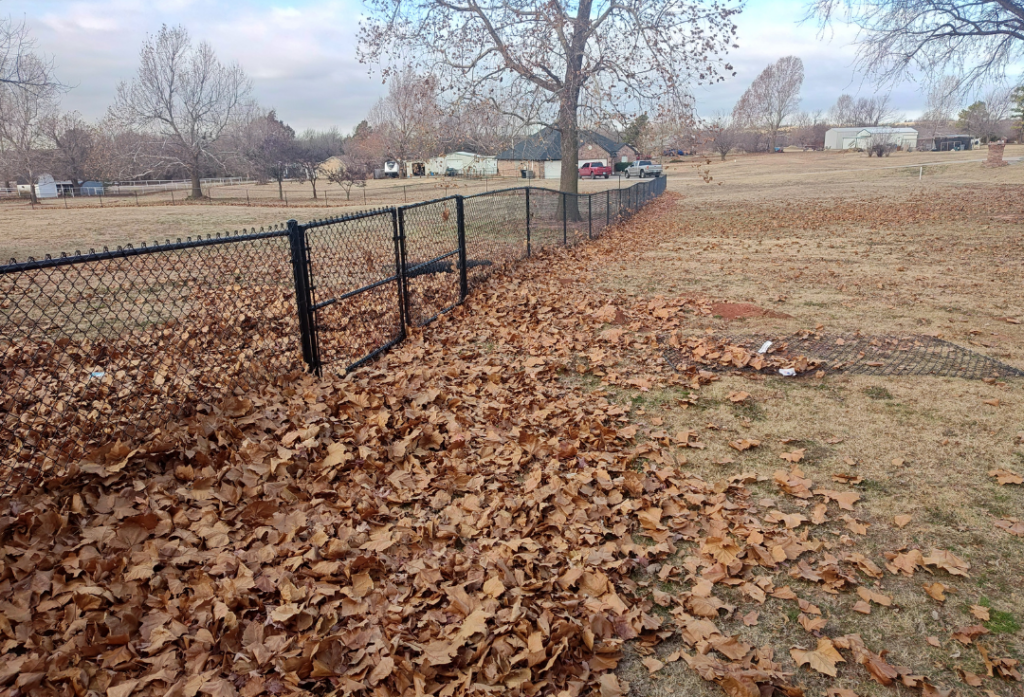
Clay movement is tied directly to moisture levels.
After heavy rain:
Soil expands and pushes against the posts
During drought or extreme heat:
Soil shrinks and leaves gaps around the posts
If you have ever seen small cracks in the ground during summer, that is the same movement happening around your fence.
And in Oklahoma, those swings can happen pretty fast.
Between storms, heat waves, and seasonal changes, your fence is constantly adjusting to the ground beneath it.
For broader context, agencies like Federal Emergency Management Agency highlight how soil and environmental conditions play a major role in structural stability. That applies to fences just as much as larger structures.
You might notice that not every fence in the neighborhood leans the same way or at the same speed.
That usually comes down to how the fence was installed.
If posts are not set deep enough, they do not have enough resistance against soil movement.
A shallow post might look fine at first, but once the soil starts shifting, it does not take much to move it.
If the soil around the post was not packed properly during installation, it creates weak spots.
Those weak spots allow water to collect and movement to happen faster.
Posts that are spaced too far apart put more stress on each section of fence.
That makes the entire structure more vulnerable when the ground moves.
This is the biggest one.
A fence built using a “standard method” that works in stable soil might not hold up in Oklahoma clay.
Local experience matters here.
Organizations like American Fence Association emphasize proper installation practices because conditions vary so much from region to region.
A lot of people assume a leaning fence just needs a quick fix.
Maybe push it back. Add some support. Patch the problem.
The issue is that if the root cause is not addressed, the problem comes back.
Fixing the symptom without fixing the soil movement or post stability is usually temporary.
That is why some fences get “fixed” multiple times and still end up leaning again.
If you catch the issue early, you can sometimes prevent bigger repairs.
Here is what to watch for:
• slight tilting of posts
• gaps forming under panels
• gates that start dragging or not lining up
• uneven fence lines when you look across the top
These small changes are usually the first signs of soil movement affecting your fence.
This is where the difference really shows.
A properly installed fence in this area is not just about materials. It is about technique.
One of the most important steps is setting posts deep enough to resist movement.
A common guideline in the industry is setting posts at about one third to one half of the fence height.
But in clay soil, professionals often go deeper or adjust based on the specific conditions.
Water is a big factor in soil movement.
If water sits around the base of a post, it increases expansion and contraction.
Good installation includes:
• proper drainage around posts
• avoiding trapped moisture
• using materials that reduce water retention
Strong fences distribute pressure evenly.
That means:
• proper post spacing
• reinforced sections where needed
• solid connection points
This is especially important for Vinyl Fencing and Wood Fencing, where panel sections rely heavily on post stability.
Not every property needs the same type of fence.
For example:
• open style fences handle wind and movement differently than solid privacy fences
• heavier materials may need stronger support systems
This is where exploring options like Metal Fencing or Farm Fencing can make sense depending on the layout and exposure.
If your fence is already leaning, the next question is usually:
Can it be fixed, or does it need to be replaced?
• only a few posts are affected
• the rest of the structure is still solid
• the issue was caused by a localized problem
• multiple sections are leaning
• posts were installed incorrectly across the entire fence
• the fence is older and already weakening
In many cases, replacing the problem posts and reinforcing the structure can extend the life of the fence without a full replacement.
Even with a good installation, maintenance still plays a role.
For wood fences, keeping the material sealed helps reduce moisture absorption, which indirectly helps with stability.
That is where Fence Staining and Sealing becomes important.
It is not just about appearance. It helps protect the material from the same environmental factors that affect the soil.
This is one of those areas where local experience really matters.
A contractor who understands:
• how clay behaves
• how weather patterns affect soil
• how wind interacts with different fence styles
is going to build a fence that lasts longer.
State level organizations like Oklahoma Department of Emergency Management regularly emphasize how environmental conditions impact structures across Oklahoma. That same understanding applies on a smaller scale to fencing.
If there is one thing to remember, it is this:
Leaning fences are not random. They are usually predictable.
And that is actually good news.
Because once you understand why it happens, you can build or fix a fence the right way.
The goal is not just to install a fence that looks good today.
The goal is to install one that still looks straight after:
• heavy rain
• summer heat
• seasonal soil movement
Because clay soil expands when wet and pushes against the posts, causing them to shift.
Dry conditions cause the soil to shrink, which loosens the support around posts and makes them easier to move.
Yes, if the posts are reset properly and the underlying issue is addressed. Temporary fixes usually do not last.
Yes. Clay soil movement is one of the most common causes of fence issues in this region.
If your fence is leaning, it is not just bad luck. It is a combination of soil, weather, and installation.
The good news is that when those factors are handled correctly, fences can hold up really well here.
If you are planning a new fence or dealing with one that is starting to shift, take the time to do it right the first time.
Explore your options with Vinyl Fencing, Metal Fencing, Farm Fencing, Commercial Fencing, and Fence Staining and Sealing, and make sure the installation matches the conditions of your property.
Because in Oklahoma, what happens below the ground matters just as much as what you see above it.